
FOLD & SNAP
DES 100
This is the first assignment that I did for Design 100, and it is overall a fun process of creating. The work itself is all about experiencing a design process. All the things are needed for this assignment; you need your hand, a background for taking photos, and origami papers for folding!

STEP ONE
Brain Storming
I made a rough mind map on how these papers can be folded to start the assignment. I came up with five approaches to get 50+ patterns/textures.
The first thing that comes to my mind is geometrical folds, such as folding the paper in half and folding it again to get four squares; or diagonally to get triangle shapes.
And the next thing that I immediately come up with is symmetrical folding, which overlaps with the geometric approach. Still, this one can have a wide range from simple to complex patterns, many ways waiting to explore, from the flat 2D forms of 3D patterns like architectural stand-up paper folds.
In contrast to symmetry, there are asymmetrical ways of folding. This one doesn't need to consider the folding process because it's irregular, so many things can experiment.
Then I thought about deconstructing. However, we can't fold, for example, an origami bird. It can be done to fold it into an origami bird and then fold it back to the original paper, so only the texture created during this process is kept.
STEP TWO
Folding Process Explained
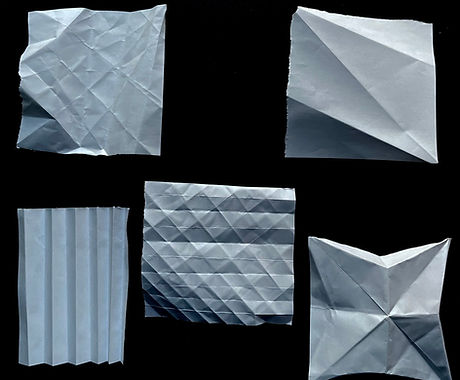
PICTURE 1
This is the first five-folds that I did. I didn't follow a strict, systematic way when I folded these papers. I think of the five approaches that I did a mind map. And the first five patterns each represent one or two approaches. The top left one is irregular and asymmetrical; the top right one is symmetrical. The middle one is geometrical consists of multiple squares. The left one in the corner is the 3D pattern. I folded it into little strips back and forth to get the And the last one is a deconstructed origami bird.

PICTURE 2
These are the last four attempts that I made. I was getting stuck creating different patterns when there are10 more left to go. At that point, I felt like I had tried everything I could. So I took a short break and looked back on those other forty. I was trying to experiment with more complicated forms for the previous ones. So I decided why not try the most straightforward way of doing it. Maybe it's just like the famous quote" Less is more," folded in half is also a way of folding.


STEP THREE
REFLECTION ON THE DESIGN PROCESS

TOP THREE PICKS
The reason why explained & reflected
These are three of my favorite folds among the 50 patterns that I created throughout the process. All three of these designs are stereoscopic in patterns. But they are not quite the same as for symmetric aspect, the one in the top right corner is asymmetrical, contrasting to the rest of the two. The top right one has a radioactive pattern to it, visually emphasizing the shape of the paper. The top left and the middle one have a similar rhythm flow in pattern. But the top left one has more of a complex and enriched texture compared to the middle one.

FINAL DESIGN
Reflection on the Final Design
This is my final choice, I choose this one over the other two above because I like the pattern and the rhythm flow of this design the most. This piece has a mosaic texture to the folding, and I emphasize that texture using a black background and cold lighting.